Tuesday, January 19, 2010

Additional Info.


Properties of Reflexes: a)reflexes are slower than conduction along an axon b)several weak stimuli presented at slightly different times or slightly different location produce a stronger reflex than a single stimulus does c)when one set of muscles becomes excited, a different set becomes relaxed.

temporal summation- repeated stimli within a brief time have cumulative effect.

a set of nerves called the sympathetic nervous system accelerates the heart beat, relaxes the stomach muscles, dilates the pupils of the eyes, and regulates many other organs.

Major synaptic events:
  1. The neurons synthasizes chemistries that serve as NT
  2. the neuron transports the peptide NT to the axon terminals
  3. AP travel down the axon. at the presynaptic terminal, an AP enables CA++ to enter the cell
  4. the released molecules diffuse across the synaptic cleft, attach to receptors, and alter the activity of the post-synaptic neuron
  5. the NT molecules separate form their receptors
  6. the NT molecules may be taken back into the presynaptic neuron for recycling or may diffuse away.
Spatial summation- don't have to be coming from the same portion of the brain, but will have to arrive together.

Temporal summation- simultaneously arriving at the axon hillock and bombarding it with info at different times

Basal Ganglia are a collection of subcortical nuclei and consists of Globus pallidus, Caudate nucleus and putamen. Basal ganglia are involved in the control of movements in the limbic system:
  • hippocampus-memory
  • Amygdala- aggression, fear
  • Mamillary Bodies- looks like boobies!
  • Fornix
  • Thalamus/Hypo t.
  • Cingulate cortex
Cerebral Cortex has two hemispheres and connects by the corpus collosum.

Vestibular system- our sense of balance and movement
  • semicircular canals- sensitive to 3 dimensions of space
  • saccule
  • utricle
Gravity and movement displace hair cells- contains "gel" and otoconia
Vestibular system compensates for bodily movements rather than the visual target. If gel is removed, what happens? Sense of balance destroyed? Equalibrium destroyed!!

Somatosensation "Body Awareness"

Cutaneous sense: (on our skin)
  • pressure
  • temp
  • vibration
  • pain
pacinian corpuscle: detects sudden displacements or high frequency vibrations on the skin meissners corpuscles: sudden displacement and low frequency vibrations of skin free nerve endings: pain and temp ruffini endings: stretch of skin (indian rug burn) merkels disks: indentation of skin

phantom pain/itching: nerves and azons still try to send signals. The brains cortex for that limb connects to other parts of the body to stay into work. An itch on the chin (new) will feel tickling or touch on arm (amputated).

January 19, 2010


Exam on Tue. of next week (8:30a), bring questions on exam this Thu.

notes in this color are additional info not covered in class.

Review on AP.

AP is all voltage versus chemical, post-synapse is both. Some leaks occur within the postsynaptic membrane due to chemical issues. Immediately after an action potential the cell is in the refactory period during which it registers the production of further action potentials. In the first part of this period, the absolute refactory period, the membrane cannot produce an action potential, regardless of the stimulation. Then the relative refactory period, a stronger than usual stimulus is necessary to initiate an action potential. Axon hillock is the swelling where the axon exits the soma.

When you think of the Reflexive Arc (see seperate post for this) think of the movie "Benchwarmers"

Glia provides:
  • physical support
  • protection for neurons
  • control of nutrient flow
  • facilitate neural communication
  • synchronized neurl activity
  • guide neural migration
  • phagocytosis- the cleanup of damaged or dead areas


see image here for a break-down of AP. There is a 'war' between the EPSP and the IPSP for dominance in the resting potential. When the potential reaches the threshold (-35 mV) there will be an instantaneous rise in EPSP and an AP is fired.


Developmental categorization of the CNS

(from bottom of nervous system to top)

Myelencephalon- medulla oblengata - vital functions such as regulation of the cardiovascular system, breathing, and skeletal muscle tone ~maintaining blood pressure

Rhombencephalon "hindbrain" (shared between medulla and pons) cranial nerves

Metencephalon- pons -control of sleep and arousal
(inferior olivenucleus)
- cerebellum -involved in balance and motor control

Mesencephalon "midbrain" Tectum is the dorsal portion of midbrain. Superior & inferior colliculli are involved in the visual and auditory localization. Tegmentum in the portion of the midbrain located under the tectum and consists of the mezalimpic pathway:
  • anterior end of the reticular formation
  • periaqueductal gray- deals with pain
  • Red Nucleus- motor movement
  • Substantia nigra- movement

Diencephalon -thalamus -contains nuclei that recieve sensory information and transmits it to the cortex
-hypothalamus -contians nuclei involved in the four F's (fight, flight, feeding and..... mating), control fo the autonomic neruons system and pituitary.

Telencephalon - cerebral cortex -basal ganglia -limbic system Basal ganglia is responsible for repitition of behavior (like the song stuck in your head now, *see seperate post for brain functions)

(see 3-6 in coloring book for Formation of Spinal Cord)

Spinal Reflexes. When your knee jerks there is an AP afferant (input) message that goes to your spinal cord and tells your brain that you have just experienced a 'pain'. The AP (in blue) goes to your dorsal root ganglion inside the spinal cord and alerts the brain through the CNS. EPSP is sent to your motor neuron (red) to form an efferent (output) action to flex your muscle in response to the 'pain'. GABA (green) is introduced as the contract in muscle, or to make it stop moving. (see my personal notes if this doesn't make too much sense)

Vestubular System (terms not needed to know, also in txt book 7.3) within the saccule, one of the semi-circular canals, there exists the macula where our sense of bodily equilibrium (balance) lies. The hairs within the macula are submerged in a liquid that, when the liquid is sloshed around the movement of the hairs indicates that your head is either tilted or you are tilted due to too many ethenol beverages (alcohol). The hairs serve to aid your balance and detect movement.

Body sensory
-hairy skin and glabrous skin (hairless)
-layers of skin
  • epidermis
  • dermis
  • subcutaneous tissue (a.k.a. hypodermis, fat)
-touch receptors-mechanoreceptors
-touch pathways

Four classes of sensory axons differ in size and speed. The larger the cable, the more electricity it sends. (do not need to know, see fig. 7.16)

Dermatomes related to dorsal roots (not routes, haha)
-Cervical
-Thoracic (which dinosaur belongs here? JK)
-Lumbar
-Sacral

Somatosensory Cortex (*fig. 7.18)
-medial lamniscous sensory pathway carries touch info to CNS.

In the medulla (myelencephalon), located above the cervical, two things occur within it. Synapse and decussation, a crossover like in the optic nerves (decussation occurs in the cuneate and gacilis nuclei).


After decussation(dee-kyu-zeh-shun), touch information is arranged spatially within the medial lemniscus. What does that mean? Who knows but the professor, so ask him.

medulla- touch info =>ipsilateral->contralateral ascending pathway.

The somatosensory cortex is located in the pariatal lobe, in which the somatosensory info is processed by the ventral prosterior and intralaminar nuclei of the thalamus.

Why the sulci you may ask? Well I did ask that question! haha! The reason why there are sulci or fissures, is so there will be more surface area for information to be processed, developed and sent. Remember the electric cables? Same thing, the larger the surface area the greater the conductivity.
______________________________________
words to know

sulcus/sulci
gyrus/gyri

interneurons= intralaminar of spinal cord
ipsilateral=same
contralateral=opposing

Thursday, January 14, 2010

January 14, 2010

ovum+sperm= zygote -> mitosis (cell division and replication) + differentiation= homosapien
Genetics=DNA (aka, genome)

human genome= the hypothesis was, that we have at least 100,000 genes. When in actuality we have <18,000 style="font-weight: bold;">gene= DNA sequence producing a protein. that extra "junk" DNA is a regulation/information to the construction of an eventual homosapien.

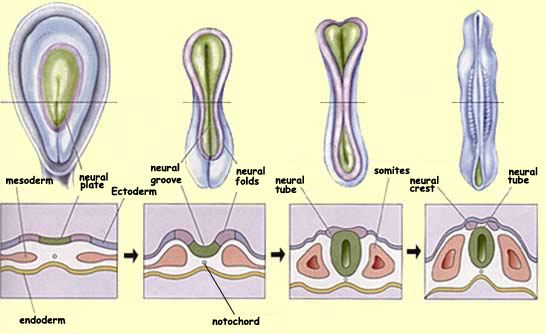
Zygote is consisted of three layers
  1. *ectoderm-> nervous system and tissues
  2. mesoderm -> structure of bodies and urogenital
  3. endoderm -> most organs including GI lumen (all the organs involved in the passing of food from mouth to rectum)
Ectoderm develops within 3-4 weeks of pregnancy. "Neuroplate" are the cells destined to become nervous tissue in the CNS and PNS. (see pg. 135 5.14 in book)

neural tube-becomes ventricals and central canal of spinal cord. During its "building" process, it begins to fold over, then merges to create the ventrical. Within the CNS it further differentiates into the determination of the cell type. (see image here)

The SIX steps to becoming a human:
  1. Continues mitosis and differentiate (a slow change) neurons and glia- cells are produced along the midline (proximal) and proceeds laterally (distal) as they mature and change membrane markers (proteins or glycoproteins)
  2. Migration of neuroblasts to proper location (see image here)- migration is navigated by radial glia which form a sphere with spoke-like structure.
  3. Further differentiation into neuronal types- differentiation is produced by the presence of substances within the environment. Referred to as hormone soluble substances that effects gene transcription, may be either protein or molecules made by protein (e.g. steroids). Differentiation occurs within the cortex from inside-out, the outer cells are the most different.
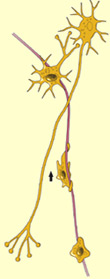
  4. Formation and strengthening of connectivity- axons and dendrites increase in connectivity (occurs by growth), sometimes groups of axons get together in fasciculation (a bundle of nerve fibers, myelinated or unmyelinated).
  5. Rearrangements of neural connectivity- form a synapse=> organ(muscles) or neuron. Maintaining and developing a synapse that requires activation- grouping of receptor proteins. during activity and maturation the target cell will release substances that maintain the axon and dendritic (I know that's not a word...) connections.*Nerve Growth Factor (NGF)
  6. Apoptosis (a programed and necessary cell death where the inaction of apoptosis to a cell causes cancer within that cell) and further rearrangement of neuronal connections. If a connection is lost the neuron may die, it is also possible to jsut lose that one connection (like pruning)
Myelination begins in the spinal cord and proceeds in a rostral direction and eventually completes the process in the prefrontal cortex (the 'self' area of the brain) during transportation period from adolescents to early adulthood. Interestingly enough! this is the time frame where schizophrenia developes. Malfunction of the PFC (prefrontal cortex) is one of the few commonalities in all types of schizophrenia.

*words to know

mitosis in this case is used to explain the non basic (two cells into four cells into eight...) but that the cells travel upon replication and from there replicate while traveling or reaching destination. i.e. the mitosis of a brain cell that continues to build the rest of the brain within the development of the zygote, does not restrict to the brain!


SEE YOU NEXT CLASS!